Concepts
An experiment is a benchmark of a DBMS in a certain host setting and a specific benchmark setting.
A host setting consists of
a DBMS (as a docker image)
a volume (containing some data)
init scripts (for pre-loading and post-loading)
A benchmark setting consists of
a number of client processes
a number of runs per connection
a maximum timeout
a lot more, depending on the benchmark tool, e.g. DBMSBenchmarker
Workflow
The management roughly means
start a DBMS and load raw data
run some benchmarks, fetch metrics and do reporting
shut down environment and clean up
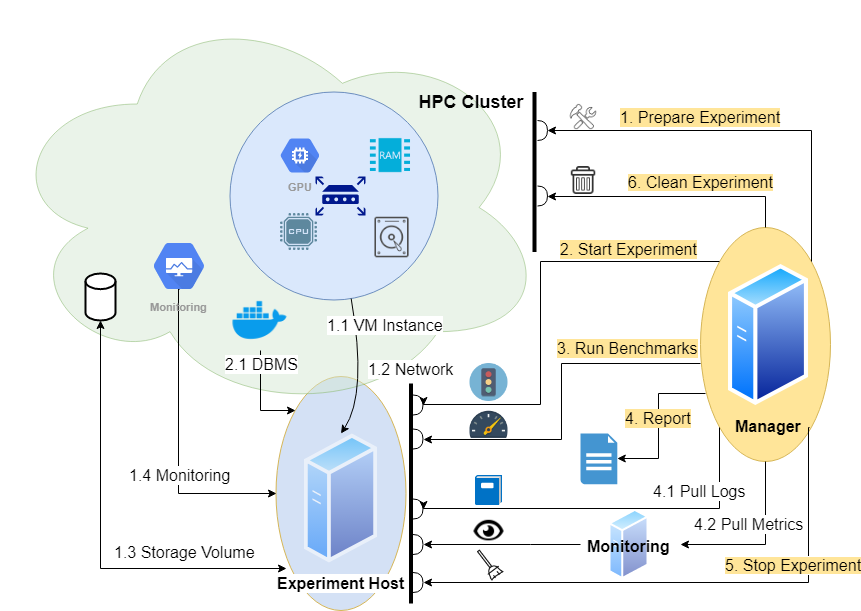
In more detail this means
Prepare Experiment
Use Virtual Machines provided as K8s nodes - create deployment
Attach Network - create service
Attach Data Storage Volume - attach PVC
Start Monitoring - start node exporters and Prometheus as docker containers
Start Experiment
Start DBMS Docker Container, upload and run pre-loading init scripts (e.g., create schema), load data, upload and run post-loading init scripts (e.g., create indexes)
Run Benchmarks
Report
Pull Logs from containers
Pull Metrics from Prometheus monitoring server
Stop Experiment
Clean Experiment
Delete deployment and services
References
You can find much more details about the concepts in the following articles. If you use Bexhoma in work contributing to a scientific publication, we kindly ask that you cite our application note [2] or [1]:
Erdelt P.K. (2021) A Framework for Supporting Repetition and Evaluation in the Process of Cloud-Based DBMS Performance Benchmarking. In: Nambiar R., Poess M. (eds) Performance Evaluation and Benchmarking. TPCTC 2020. Lecture Notes in Computer Science, vol 12752. Springer, Cham. https://doi.org/10.1007/978-3-030-84924-5_6
[2] Orchestrating DBMS Benchmarking in the Cloud with Kubernetes
Erdelt P.K. (2022) Orchestrating DBMS Benchmarking in the Cloud with Kubernetes. In: Nambiar R., Poess M. (eds) Performance Evaluation and Benchmarking. TPCTC 2021. Lecture Notes in Computer Science, vol 13169. Springer, Cham. https://doi.org/10.1007/978-3-030-94437-7_6
[3] DBMS-Benchmarker: Benchmark and Evaluate DBMS in Python
Erdelt P.K., Jestel J. (2022). DBMS-Benchmarker: Benchmark and Evaluate DBMS in Python. Journal of Open Source Software, 7(79), 4628 https://doi.org/10.21105/joss.04628
[4] A Cloud-Native Adoption of Classical DBMS Performance Benchmarks and Tools
Erdelt, P.K. (2024). A Cloud-Native Adoption of Classical DBMS Performance Benchmarks and Tools. In: Nambiar, R., Poess, M. (eds) Performance Evaluation and Benchmarking. TPCTC 2023. Lecture Notes in Computer Science, vol 14247. Springer, Cham. https://doi.org/10.1007/978-3-031-68031-1_9